


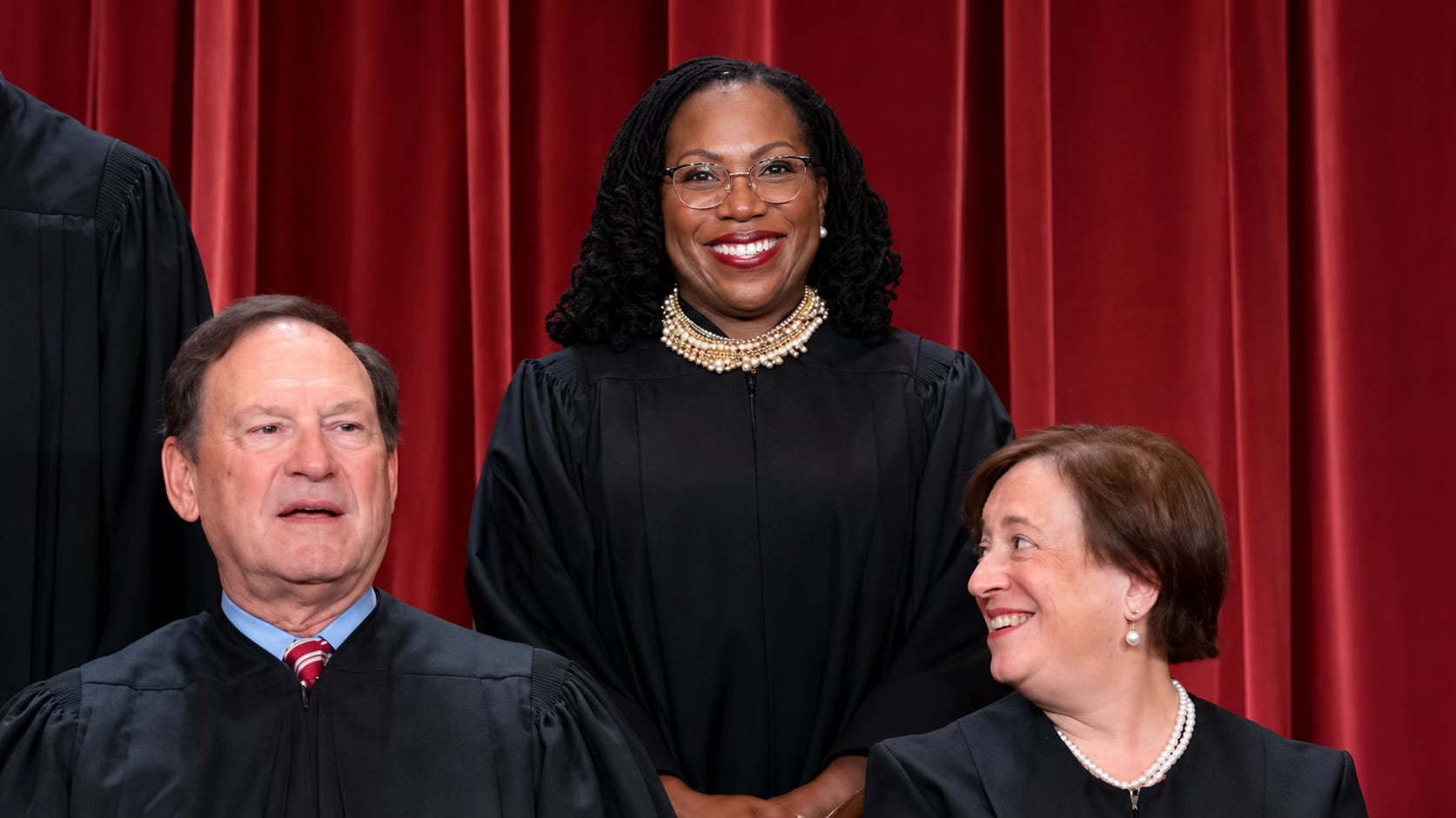
Justice Ketanji Brown Jackson dissents as the high court allows New Hampshire to enforce disputed election guidance ahead of November 3.
The Supreme Court handed New Hampshire a significant election-law victory Thursday, allowing the state to enforce its voter identification guidance just 12 days before the November 3 midterm elections.
The emergency ruling temporarily blocks two lower-court orders that had restricted how election officials could implement the state’s new student identification rules.
At the center of the dispute is New Hampshire’s House Bill 323, which removed high school, college, and university identification cards from the list of documents automatically accepted as proof of identity at polling places.
The law took effect June 2, but a federal court battle over its implementation threatened to change election procedures shortly before voters headed to the polls.
The Supreme Court’s intervention means New Hampshire can continue enforcing its challenged student-ID guidance while the legal battle proceeds.
Supreme Court Intervenes Ahead of November 3
In Scanlan v. Coalition for Open Democracy, No. 26A512, the justices granted New Hampshire’s emergency request to pause two federal court orders.
The dispute centered on whether local election officials could consider student identification cards alongside other evidence when voters used alternative identity-verification procedures.
U.S. District Judge Joseph Laplante had allowed the underlying law to remain in effect but blocked state guidance that prevented election officials from considering student IDs as part of those fallback procedures.
New Hampshire officials argued that changing election instructions so close to November 3 could create confusion among voters and poll workers.
The Supreme Court agreed that the timing of the lower-court intervention was a critical consideration.
The justices cited the longstanding principle that federal courts should generally avoid changing election rules immediately before an election unless extraordinary circumstances justify intervention.
The Court concluded that the district court had not established sufficient grounds to depart from that principle.
Ketanji Brown Jackson Breaks With the Court
Justice Ketanji Brown Jackson was the only justice publicly identified as dissenting from the emergency order.
Jackson argued that the lower court had not actually changed New Hampshire’s election laws.
Instead, she maintained that the district court had required state officials to correct guidance and public statements that could mislead voters about the identification documents permitted under existing law.
In Jackson’s view, correcting potentially misleading instructions would reduce confusion rather than create it.
The Supreme Court did not release a complete justice-by-justice vote tally.
Student Identification Rules Spark Constitutional Challenge
Under New Hampshire’s updated law, student identification cards no longer automatically qualify as acceptable voter ID.
Voters may instead present identification such as a driver’s license issued by any state, a U.S. passport, military identification, or certain other government-issued documents.
State officials defended the restrictions by arguing that student IDs may lack security features, including expiration dates and protections against counterfeiting.
Voting-rights organizations challenging the rules contend that the restrictions could disproportionately burden students who do not possess a driver’s license or passport.
The challengers have raised constitutional objections under the First, Fourteenth, and Twenty-Sixth Amendments.
The Supreme Court’s emergency order does not resolve those constitutional questions.
What Happens Next?
The ruling is a temporary stay rather than a final judgment on the legality of New Hampshire’s voter identification requirements.
The stay remains in effect while the case proceeds through the U.S. Court of Appeals for the First Circuit and any timely request for Supreme Court review.
If the Supreme Court declines to hear the case, the stay will expire. If the justices agree to review it, the stay will continue until the Court issues its judgment.
For the November 3 midterms, however, the immediate impact is clear.
New Hampshire election officials may enforce the challenged student-ID guidance, avoiding another court-ordered change to voting procedures in the final days before Election Day.
The decision also places renewed attention on the Supreme Court’s approach to last-minute election litigation as states prepare for one of the country’s most closely watched midterm elections.
Read the full Supreme Court ruling and Justice Ketanji Brown Jackson’s dissent here:
SUPREME COURT RULING: Scanlan v. Coalition for Open Democracy (PDF) »
A problem I see with allowing student IDs as proof at the voter booth is: there is no difference between a US citizen's student ID opposed to a non-citizen's student ID.
During my student years, my student ID didn't designate my citizenship.
Ketanji Bojangles strikes again!